Key Takeaways: Infidelity Statistics and Research for 2026
- 20–25% of marriages experience infidelity at some point, with 2–4% of spouses engaging in sexual infidelity in any given year
- Infidelity affects 44% of unmarried couples and 18% of married couples in the U.S., and is the primary driver behind 50% of all divorces
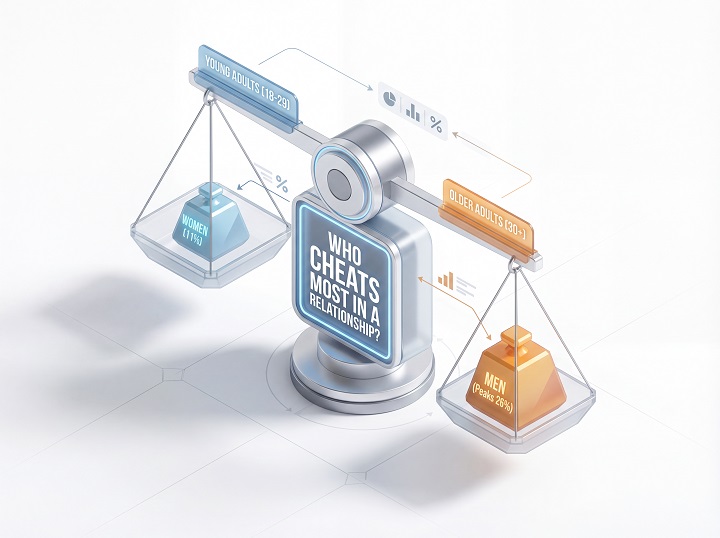
- Among adults 18–29, women are slightly more likely to cheat than men (11% vs 10%) — this reverses in older age groups, peaking at 26% for men in their 70s
- 60% of men find sexual infidelity more distressing, while 83% of women report greater distress over emotional affairs
- Only 15% of relationships survive the discovery of an affair without professional intervention — specialized therapy boosts long-term reconciliation rates to 60–75%
- In Canada, 13% of men and 8% of women admit to having cheated, while 23% of men and 20% of women say they have seriously considered it
- 9% of suicide cases involved spousal infidelity as a factor in the final 24 hours — discovery of an affair is a serious mental health risk
Last Updated: March 8, 2026
Who Cheats Most in a Relationship? Insights From the Most Recent Studies for 2026
Infidelity remains a complex and pervasive challenge to relationships worldwide.
This article presents an up-to-date, comprehensive look at infidelity, addressing who cheats most in a relationship and exploring the broader picture based on the newest 2024 and 2025 peer-reviewed findings for the most accurate understanding of current trends.
Using this updated data, we examine infidelity’s scope across age, gender, and culture, alongside its mental health and relational impact. Instead of relying on personal stories, these facts use modern research to show why people cheat and how it impacts their relationships.
- Who Cheats Most in a Relationship? Insights From the Most Recent Studies for 2026
- The Scope of Cheating: Western vs Global Infidelity Rates
- Men vs. Women: Statistical Proof of Different Cheating Styles
- Finding the Truth: How Are Most Affairs Exposed?
- Infidelity-Based Trauma: The Mental Health Impact
- Can the Relationship Survive? Reconciliation Success Rates
- Ongoing Research Gaps & Future Directions
- About the Author
The Scope of Cheating: Western vs Global Infidelity Rates
Just How Widespread is Cheating?
Various studies summarized by Fincham & May report that roughly 20-25% of marriages experience infidelity at some point with estimates of 2-4% of spouses engaging in sexual infidelity in any given year.
A 2025 analysis confirmed these trends, finding that infidelity affects 44% of unmarried couples and 18% of married couples in the U.S. Furthermore, it remains the primary driver behind 50% of all divorces (Brenna Harper, 2025).

Country & Cultural Differences
Prevalence varies notably by country and culture.
The United States tops self-admitted infidelity rates from general surveys at a startling 71%, followed closely by Germany at 68% and the UK at 66% (PrNewswire, 2024). This data suggests a high rate of admitted unfaithfulness in Western nations, though definitions of “cheating” can vary.

While Americans report higher rates, moral attitudes differ across the Atlantic; Pew’s original 2013 global survey reports 47% in France saying infidelity is morally unacceptable, compared to a staunch 84% of Americans and 76% of Britains who condemn the behavior (Statistica, 2014).
Workplace & Digital Origins
Beyond where people live, where affairs begin is statistically significant.
The workplace is a primary breeding ground for illicit romance, with 31% of affairs involving a co-worker. Additionally, the digital age has introduced new avenues for unfaithfulness; studies indicate that nearly two-thirds of Tinder users are already in a committed relationship (29 Secrets, 2024).
Age & Gender Patterns
Age also plays a role, but not always in expected ways. While the general assumption is that men cheat more, the gap fluctuates significantly with age.
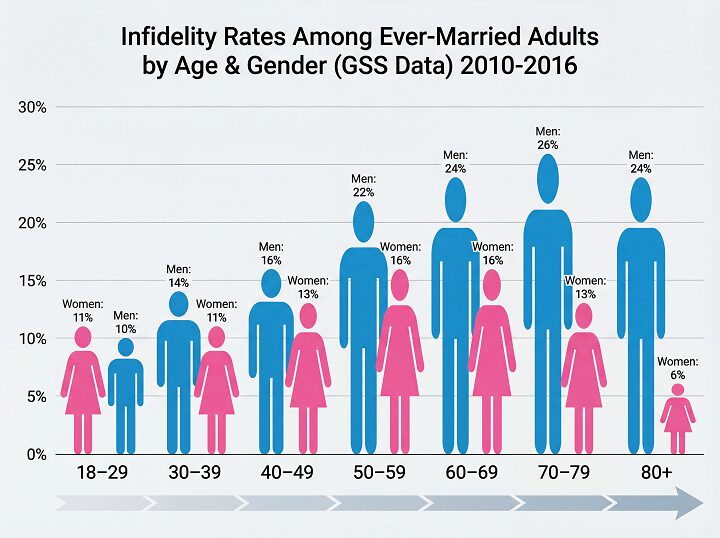
Among young adults (ages 18-29), women are actually slightly more likely to cheat than men (11% vs. 10%). This trend reverses in the 30-39 age bracket, where men overtake women (14% vs. 11%). The divergence becomes most extreme in later life.
So while the stereotype of the philandering older man holds truth—peaking at 26% in his 70s—women also see a significant rise in infidelity during their 50s and 60s before tapering off (Institute For Family Studies, 2018).
Infidelity Rates for Ever-Married Adults (GSS 2010–2016)
| Age Group | Men’s Infidelity Rate | Women’s Infidelity Rate | Most Likely to Cheat |
|---|---|---|---|
| 18-29 | 10% | 11% | Women |
| 30-39 | 14% | 11% | Men |
| 40-49 | 16% | 13% | Men |
| 50-59 | 22% | 16% | Men |
| 60-69 | 24% | 16% | Men |
| 70-79 | 26% | 13% | Men |
| 80+ | 24% | 6% | Men |
This survey focused on individuals who have been married at least once in their lifetime, regardless of their current marital status, as infidelity rates for never-married people (e.g., in dating relationships) tend to be higher overall.
Canadian Context
While hard academic numbers can be sparse for Canada, survey data provides a clearer picture than simple speculation. According to the National Post’s article in 2015, 13% of Canadian men and 8% of Canadian women admit to having cheated, while 23% of men and 20% of women say they have seriously considered it.
A Global News report in 2015 cited Ashley Madison data showing nearly 1 in 5 Ottawa residents (~189,000 users) had signed up to the site catering to extramarital affairs—making it Canada’s infidelity capital per capita at the time.
Men vs. Women: Statistical Proof of Different Cheating Styles
Pop culture loves to pit the genders against each other when it comes to cheating, but what do the numbers actually say? Some clear differences emerge, particularly in the types of betrayal that cause the most distress and the underlying motivations for seeking an affair.
Emotional vs. Sexual Infidelity Distress
Gender differences in emotional response to infidelity are stark and highly consistent across studies. When asked to imagine their partner having a deep emotional attachment or passionate sexual intercourse with someone else:
- Men: 60% found sexual infidelity more distressing than emotional cheating, compared to the 40% of men who report greater distress over emotional betrayal.
- Women: Conversely, 83% of women reported more distress over an emotional affair, with only 17% of women prioritizing sexual infidelity as the most upsetting form of betrayal (Buss D.M., 1992).

For women, emotional betrayal often signals the withdrawal of the partner’s resources and commitment, threatening the stability of the relationship.
A 2018 replication by Buss confirmed similar results across 3,578 participants in 37 nations: Men 56% on average selected sexual infidelity as more distressing while women 65% on average selected emotional betrayal as more distressing. The paper confirmed robustness across cultures, methods (physiological, self-report, behavioral), and samples—including actual infidelity experiences. (Buss D.M., 2018)
Motivation & Affair Type
These differences in distress are mirrored in the motivations and the nature of the affairs themselves.
Primary Motivation
Men show greater interest in sexual variety, with 34% agreeing to casual sex with a stranger (vs. 12% of women) and report higher rates of multiple concurrent partners during relationships (18% men vs. 5% women). This supports men pursuing primarily physical affairs, contrasting women’s lower overall lifetime infidelity (11%) and emotional motivations (Hughes, Harrison, & Gallup, 2004).
This is further highlighted by pre-affair relationship satisfaction: 48.4% of cheating women felt their relationship was “bad” beforehand, compared to only 34.1% of cheating men (Nickerson et al., 2023).
Affair Partner & Nature
The “who” and “how” of the affair also splits along gender lines, reflecting the difference in emotional versus physical seeking:
| Affair Partner | Men | Women |
| Co-worker | 42.0% | 35.8% |
| Friend | 17.4% | 28.0% |
| Stranger | 14.8% | 12.0% |
Men are noticeably more likely to engage in affairs with co-workers or strangers, suggesting a higher tendency toward opportunity-based or situational encounters. Women, on the other hand, show a stronger leaning toward affairs with friends, with 28% reporting a friend as the affair partner compared to 17.4% of men (Hughes, Harrison, & Gallup, 2004). This contrast points to a meaningful pattern: while men’s affairs more often emerge from chance interactions, women’s affairs are more likely to develop from existing emotional connections.

Moreover, 79.8% of women report their affair was both physical and emotional, while 21.4% of men’s affairs were purely physical, compared to 10.4% for women (Nickerson et al. , 2022).
Regret and Fallout From an Affair
The emotional fallout of infidelity also shows a gender divide in the degree of remorse and the long-term commitment to the original partner:
- Regret: Over 82.5% of cheating men feel regret afterward, but only 67.4% of unfaithful women do. Women are more likely to feel “in love” with an affair partner, perhaps tempering their remorse.
- Love for Spouse: Despite cheating, 88.7% of men reported still loving their spouse/partner during the affair, compared to 71.1% of women.
- Reconciliation: Post-affair, men are more likely to remain committed to the original relationship, with 82.1% of men who strayed staying with their original partner, versus 71.3% of women (Nickerson et al., 2023).

In summary, while men may cheat more overall, women’s affairs are often deeper, more emotionally involved, and more likely to stem from a perceived deficiency in the primary relationship. The cheater’s gender influences every aspect of infidelity, from the motivation to the long-term fallout.
Finding the Truth: How Are Most Affairs Exposed?
In the high-stakes game of infidelity, secrecy is the rule, but discovery is often inevitable. Understanding how the truth surfaces reveal much about the modern landscape of betrayal.
The Confession Gap
Honesty is rarely the first policy when it comes to infidelity.
In surveys of straying partners, only 15% confessed of their own accord without being confronted. Even when the betrayed partner discovered the affair and confronted them, only about 21% of significant others came clean right away (Nickerson et al., 2023).
Instead of immediate candor, most partners (over 75%) initially deny, minimize, or lie about the affair—a pattern known as ‘trickle truth,’ where details emerge only with undeniable proof (Nickerson et al., 2023).
A survey of 94,949 individuals, 56.8% confessed independently, 21.5% were exposed through partner-led investigations (often via snooping or direct evidence), and 10.7% were revealed by third parties like friends or the affair partner (Fisher, 2024).

Infidelity-Based Trauma: The Mental Health Impact
Depression Risk
The psychological damage from infidelity is often as severe as the shock experienced after a sudden death.
Women who experience “humiliating marital events,” such as infidelity or threats of divorce, are 6 times more likely to be diagnosed with a major depressive episode than those who do not (Cano A, O’Leary KD., 2000).This shocking statistic illuminates infidelity’s hidden cost: it is not just a relationship crisis, but a mental health emergency.
PTSD-Like Symptoms
The emotional trauma of betrayal can trigger symptoms identical to Post-Traumatic Stress Disorder (PTSD), including flashbacks, intrusive thoughts, and hyperarousal.
Clinicians report 30-60% of betrayed partners show PTSD-like symptoms following the discovery of an affair (Romanoff S., 2021). In a study of young adults specifically, 45.2% reported symptoms suggesting probable “infidelity-related PTSD” (Roos CR, et al., 2019). Victims often meet every diagnostic criterion for PTSD except for the “direct life threat,” leading researchers to coin the term “Post Infidelity Stress Disorder.”
A 2024 study of 140 young adults found infidelity worsens PTSD through emotional detachment (unfaithful coping) and betrayal trauma (betrayed hypervigilance), with symptoms persisting 6-24+ months (Adam Galovan, Douglas B. Hardy, 2024).
Suicide Risk
Most alarmingly, discovering a partner’s affair dramatically raises short-term suicide risk.
A forensic analysis of suicide cases found that for 9% of the victims, spousal infidelity was a factor in the final 24 hours of their life (Rokach A, Chan SH., 2023). A heartbreaking correlation that underscores the acute danger of the initial discovery phase.
Long-Term Effects
The long-term impacts can be just as severe. Anxiety, obsession, self-blame, and disintegration of self-worth are common emotional responses.
Researchers are now pushing for “infidelity-based trauma” to be a clinically recognized focus, noting that for many, the psychological damage persists long after the relationship issues are resolved (Rokach A, Chan SH., 2023). Validation and specialized treatment are critical for recovery.
So, while culture often portrays infidelity as titillating or even comedic, the mental health statistics paint a different picture—one of deep heartache and destabilization. But as with any trauma, some relationships do survive.
Can the Relationship Survive? Reconciliation Success Rates
The million-dollar question after infidelity is always: can we move past this?
The unsatisfying answer is—it depends, though the odds are often stacked against the couple without intervention.
Divorce Cause Statistics
Infidelity is a leading cause of marital breakdown.
When divorced individuals were asked about the causes of the split in their relationship, 59.6% cited an affair. This percentage surged to 88.8% when divorced couples were asked while they were both present, suggesting that the issue is disclosed much more often when both partners are interviewed together. (Scott SB et al., 2013). In other words, almost 9 out of 10 divorced couples interviewed had at least one spouse who confirmed infidelity significantly contributed to their split.
Furthermore, when identifying the “final straw” that ended their marriage, infidelity was the most common reason given at 24% of individuals (Scott SB et al., 2013).
Immediate Relationship End
In a 2019 Health Testing Centers survey of 441 individuals who admitted to cheating, 55% reported that their relationship ended immediately upon discovery of the affair, while 30% attempted reconciliation but later divorced, leaving only 15% of relationships surviving (Couples Academy, 2023).

Gender Differences in Reconciliation
But some couples do choose to reconcile, and gender plays a surprising role in those odds. Men who stray are more likely to get back together with their original partner (84.6%) compared to women who stray (68.4%) (Nickerson et al., 2023).
Some researchers theorize that this reflects gendered approaches to emotional commitment in affairs. For instance, 88.7% of men reported they were still in love with their spouse while cheating, whereas only 71.1% of women felt the same. Conversely, women were significantly more likely to fall in love with their affair partner (71.8%) than men were (50.6%) (Nickerson et al., 2023).
Post-Affair Improvement & Regret
In a 2023 survey of 2,115 straying partners, 56.7% of men reported their primary relationship improved after the affair, compared to 38.7% of women. This aligns with higher male remorse rates: 82.5% of men vs. 67.4% of women felt regret (Nickerson et al., 2023).
Men also reported greater ongoing love for their original partner (88.7% vs. 71.1% women), while women fell in love with their affair partner more often (71.8% vs. 50.6% men). Long-term data suggests that for those who do not successfully reconcile or who leave for an affair partner, the future is uncertain; only 1.7% of affairs eventually turn into long-term relationships lasting 10 years or more (Nickerson et al., 2023).
Couples Therapy Success Rates
Specialized couples therapy dramatically improves outcomes.
Unassisted reconciliation after infidelity succeeds in only about 15-20% of cases while specialized therapy boosts long-term odds to 60-75% (Rachael Pace, 2024).

The American Association for Marriage and Family Therapy (AAMFT) reports 70-75% of couples experience significant relationship improvement, with 90% noting better emotional health—even if some later separate. Evidence-based methods like Gottman (70-75% sustained gains) and Emotionally Focused Therapy (EFT; 70% recovery, 90% improvement) show the strongest results (Well Marriage Center, 2022).
A 2025 meta-analysis found similar results. Approximately 60% of couples actively attempt to repair their relationship after an affair. Among those who seek therapy, success rates significantly improve, with 67-75% of couples achieving lasting reconciliation compared to a 35-45% divorce rate among those who forego professional help. Notably, the presence of genuine remorse from the unfaithful partner boosts the likelihood of successful recovery to around 80%. The analysis also highlights that, on average, the reconciliation and healing process spans from two to five years, reflecting the complex emotional work required to rebuild trust and restore intimacy (Zipdo Education Report, 2025).
Ongoing Research Gaps & Future Directions
A 2024 meta‑review of infidelity research underscores how much remains unknown, pointing to inconsistent definitions, under‑representation of diverse couples, and a pressing need for long‑term, population‑level studies to truly capture how and why affairs happen—and what helps people heal afterward (Hardy et al., 2024).
Final Thoughts
So, if you’re facing the aftermath of an affair, remember that you’re not alone. Reach out for professional support in your journey toward recovery. With insight, commitment, and hard work, some relationships do emerge stronger after infidelity. But regardless of your chosen path forward, healing is possible.
Suspecting Infidelity?
If you suspect infidelity and need concrete evidence, hiring a local professional investigation firm can help you discreetly uncover the truth, providing the proof necessary to break the cycle of accusations and denials.
For a complimentary, obligation-free consultation, please get in touch with us at 604-657-4499, info@shadowinvestigationsltd.ca, or fill out our contact form below with your preferred contact method and a brief overview of what you would like assistance with. We keep all information confidential and only use contact information to respond to inquiries.
"*" indicates required fields
About the Author