

WorkSafeBC Investigations: A Step by Step Compliance Guide for BC Employers
As an employer in British Columbia, few events are more unsettling than a serious workplace incident. Amidst the chaos of ensuring immediate safety and medical care, a daunting responsibility looms: the WorkSafeBC investigation. Where do you even begin?
With decades of experience supporting employers with workplace investigations and related challenges, I’ve seen firsthand how critical it is to approach this process with clarity and confidence.
This guide breaks down what prompts an investigation, the timelines you’re required to meet, and how to carryout a thorough review that aligns with WorkSafeBC requirements and strengthens your prevention strategies moving forward.
Here we’ll cover:
- What qualifies as a “reportable incident”
- The critical difference between a preliminary and full investigation
- Required procedures, participants and documentation
- Strategies for identifying root causes, not just worker error
- How to implement corrective actions that stick.
Most importantly, you’ll come away understanding WorkSafeBC’s prevention-over-blame philosophy and how to foster a proactive safety culture in your organization.
- WorkSafeBC Investigations: A Step by Step Compliance Guide for BC Employers
- Understanding Your Obligations: When is an Investigation Required?
- Phase 1: The Preliminary Investigation (The First 48 Hours)
- Phase 2: The Full Investigation (Uncovering Root Causes)
- Mastering the Paperwork: The Employer Incident Investigation Report (EIIR)
- Closing the Loop: Corrective Action & Evaluation
- About the Author
Understanding Your Obligations: When is an Investigation Required?
The first step to compliance is knowing exactly which workplace incidents trigger the legal duty to investigate. Spoiler alert – it’s not just for disastrous situations.
WorkSafeBC requires an investigation for any “reportable incident”, which includes:
- Serious injury to or death of a worker
- Injury requiring medical treatment (beyond first aid)
- Minor injury or near miss with potential for serious injury
- Major release of a hazardous substance
- Major structural failure or collapse
- Blasting or diving incident causing injury.
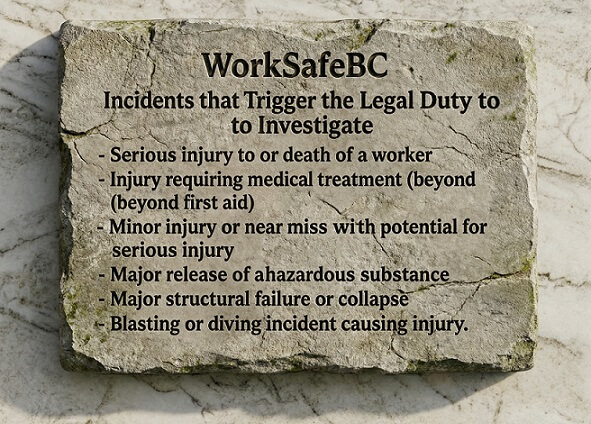
Essentially, if it’s more than a band-aid fix, involves a critical hazard, or could have been disastrous, it’s reportable. This broad net underscores WorkSafeBC’s focus on prevention – investigating close calls can avert future tragedy (WorkSafeBC – Reporting incidents).
Here’s the key: It’s not just injuries that trigger requirements. Structural collapses, and chemical leaks – even if no one was hurt – require immediate action if they could have caused harm. When in doubt, err on the side of over-reporting.
So, what does an investigation entail at this stage?
Critically, you must conduct a preliminary investigation immediately – and that means before the end of the shift. (WorkSafeBC – Conducting an employer investigation) We’ll get into those steps shortly.
First, let’s clarify what happens with first aid-only injuries. While you should absolutely record these incidents internally for pattern analysis, a formal WorkSafeBC investigation isn’t mandatory… unless it nearly caused a serious injury. Near misses matter.
Phase 1: The Preliminary Investigation (The First 48 Hours)
When a reportable incident happens, the clock starts ticking on your preliminary investigation. And that 48-hour window isn’t a suggestion – it’s the law (WorkSafeBC – Conducting an employer investigation).
Your immediate priorities are to:
- 1. Provide first aid & call for emergency services
- 2. Secure the scene to prevent further injury
- 3. Preserve critical evidence like equipment positions
- 4. Identify witnesses and affected parties.
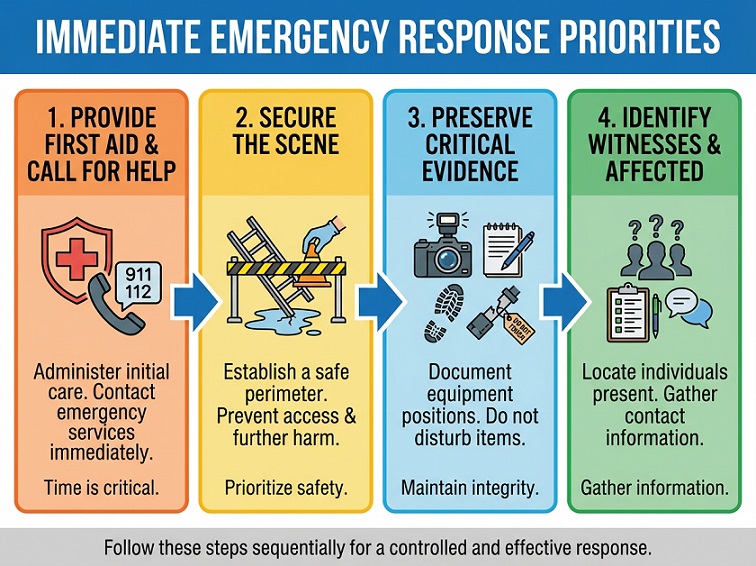
However, the real aim of this stage is to pinpoint any unsafe conditions, acts or procedures that significantly contributed to the incident. You’re not assigning blame but rapidly identifying hazards to prevent an imminent recurrence.
To guide you, let’s use an example. Say a worker slips from a ladder and fractures his leg. After ensuring his care, you’d want to immediately examine:
- The ladder’s condition and positioning
- Lighting and tripping hazards in the area
- Whether he was using 3 points of contact
- The task he was performing
- His training on ladder safety
- Any rushing or distraction factors.
Document the scene thoroughly with photos and witness statements and critically, collaborate. The law requires participation from a worker rep, a member of a Joint Occupational Health and Safety Committee (JOHSC), or union rep in this process (WorkSafeBC – Joint Health & Safety Committees).
Within 48 hours, you’ll distill this into a preliminary report identifying causative factors and recommending corrective actions. But – this isn’t the end. It’s a stopgap to enable work to resume safely while you dive deeper to prevent future incidents.
Phase 2: The Full Investigation (Uncovering Root Causes)
With immediate threats addressed, it’s time for the real detective work of the full investigation. This is where you peel back the layers to reveal not just the what, but the why.
Using the previous example, that fractured leg wasn’t just about an unsteady ladder. Why was the worker overextended? Why did he feel rushed? Were other safety procedures routinely bypassed? Is additional training needed? These are the questions that get to the root cause.
A common misstep here is to zero in on worker error and conclude the investigation. However, WorkSafeBC makes clear: “The purpose of an investigation is not to assign fault, but to uncover any underlying factors in the workplace that contributed to the incident” (WorkSafeBC – Conducting an employer investigation).
This means looking at the equipment, environment, procedures, supervision, and training – the whole system within which workers make decisions.
Tools like the “5 Whys” can help:
- Why #1: Why did the worker slip? (Ladder was unsteady)
- Why #2: Why was his weight shifted? (Overreaching)
- Why #3: Why was he overextended? (Avoiding obstruction)
- Why #4: Why was the area cluttered? (No clear housekeeping procedures)
- Why #5: Why was this tolerated? (Lax supervisory oversight).
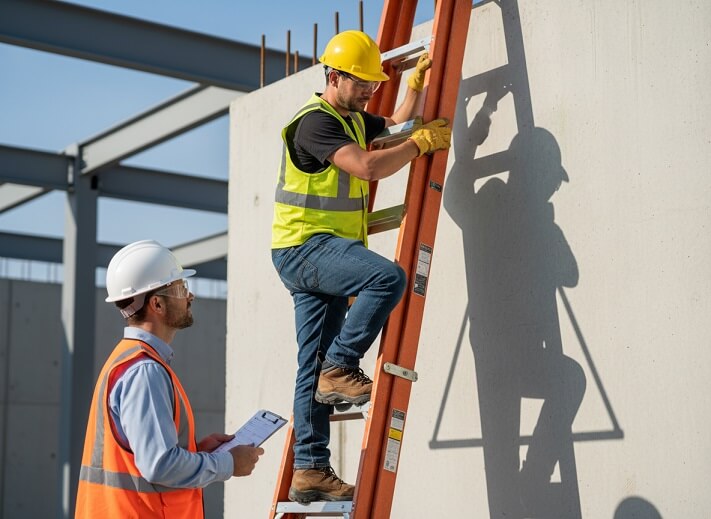
See how the focus shifts from the individual to the conditions? Effective investigations look past the obvious to uncover the safety system gaps that enabled the incident. And you have 30 days from the occurrence to submit this root cause analysis to WorkSafeBC (WorkSafeBC – Conducting an employer investigation).
The heart of this process is worker interviews. However, take care – this isn’t an interrogation. Use open-ended, non-leading questions in a neutral environment. The focus is on gathering facts to understand the Why, not to assign blame (WorkSafeBC – Reference Guide for Employer Incident Investigations).
Mastering the Paperwork: The Employer Incident Investigation Report (EIIR)
Here’s where the rubber meets the road in terms of compliance: The Employer Incident Investigation Report, or EIIR. This is your formal submission to WorkSafeBC, due within 30 days of the incident.
The EIIR (Form 52E40) is more than just a fill-in-the-blanks exercise. It’s a comprehensive narrative of the incident, investigation process, and preventive measures.
Key components include:
- Incident details (date, time, location, descriptions)
- Persons conducting & participating in investigation
- Unsafe conditions, acts or procedures identified
- Injury or damage resulting & potential for serious injury
- Corrective actions taken and outstanding (WorkSafeBC – Form 52E40).
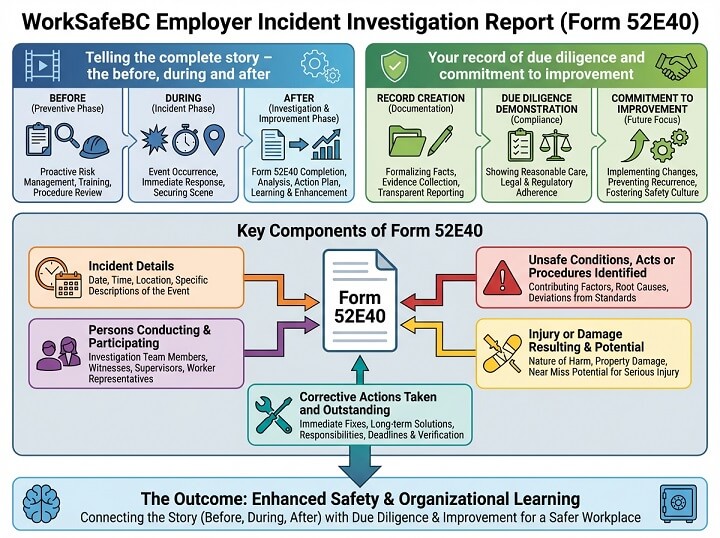
Think of the EIIR as telling the complete story – the before, during and after – for both WorkSafeBC and your internal stakeholders. It’s your record of due diligence and commitment to improvement.
A strong EIIR documents a thorough, unbiased investigation process and clearly outlines how you’ll prevent similar incidents. This is your opportunity to showcase a safety culture of continuous learning and system refinement.
Practically speaking, aim to be concise yet specific.
For example, rather than generically saying “improve ladder protocols,” pinpoint the changes, such as: “Implement 3 points of contact procedures, retrain all workers and supervisors on ladder safety, and institute weekly ladder inspections.”
One last tip: Engage your JOHSC or worker reps in both the investigation process and in shaping the corrective actions. You’re legally required to share the EIIR with them, so ensuring their buy-in up front will foster a spirit of collaboration in safety (WorkSafeBC – Joint Health & Safety Committees).
Now let’s talk about the logistics.
You have options for submitting:
- Via the online portal (fastest & preferred by WCB)
- By fax to 604-276-324
- By mail to WorkSafeBC PO Box address (WorkSafeBC – Reporting incidents).
However, here’s a pro tip: Skip the paper shuffling and use the streamlined online reporting tool. It allows collaboration, progress tracking and maintains all your records securely in one place. Work smarter, not harder.
Closing the Loop: Corrective Action & Evaluation
Submitting the EIIR isn’t the end of your responsibilities. The most critical phase is what comes after – translating those findings into concrete, sustainable changes.
WorkSafeBC is crystal clear: Employers must not only identify preventive measures but implement them “without undue delay” and monitor them for effectiveness. This is where many well-intentioned companies stumble.
Let’s revisit our ladder example. Say the investigation pinpointed the need for additional fall protection training. The EIIR is submitted, the box is checked, case closed – right? Not so fast.
A strong safety culture requires looping back around – did that training actually change behaviors? Are ladders now consistently secured? Are housekeeping protocols preventing obstructions? Continual evaluation and adjustment are key.
In practical terms, this looks like:
– Communicating investigation findings to all affected workers
– Integrating new procedures into orientations & ongoing training
– Conducting spot checks and audits on corrective measures
– Regularly reviewing incident data for trends or emerging hazards
– Refining investigation processes based on worker feedback.
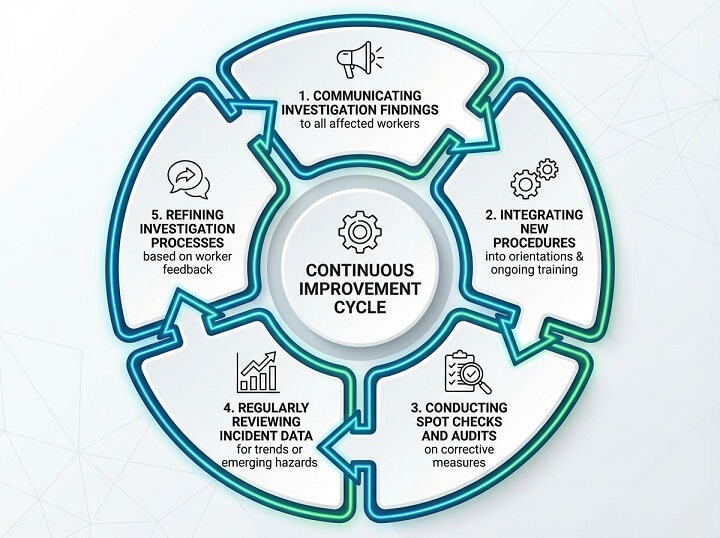
Think of it as building a living, breathing system, not a set-it-and-forget-it safety program.
By fostering a culture of open communication, active participation and continuous improvement, you’ll not only meet WorkSafeBC expectations, but you’ll also create an environment where every worker feels valued and invested in safety.
In addition, if WorkSafeBC does come knocking to audit your safety records, with this holistic approach, you’ll have a clear trail of responsiveness and follow-through. Bonus: You’ll likely see an impact on your injury rates and claims costs over time.
So, embrace the process – investigations are opportunities. Approach them with a mindset of prevention over punishment and learning over liability. Partner with your workers to build trust and know that even the most diligent organizations experience incidents – what sets safety leaders apart is how they respond.
Shadow Investigations has assisted companies across BC for decades, helping employers navigate sensitive workplace investigations with confidence. We can assist you to gather statements and evidence, conduct interviews and provide clear, defensible reporting. We act as your independent partner in establishing facts and protecting organizational integrity.
Our goal is to reduce your risk, support your decision-making, and ensure every investigation is handled thoroughly, respectfully, and in compliance with BC standards.
If you’re facing a questionable claim we’re here to help.
For a complimentary, obligation-free consultation, please get in touch with us at 604-657-4499, info@shadowinvestigationsltd.ca, or fill out our contact form below with your preferred contact method and a brief overview of what you would like assistance with. We keep all information confidential and only use contact information to respond to inquiries.
"*" indicates required fields
About the Author